What is turbidity?
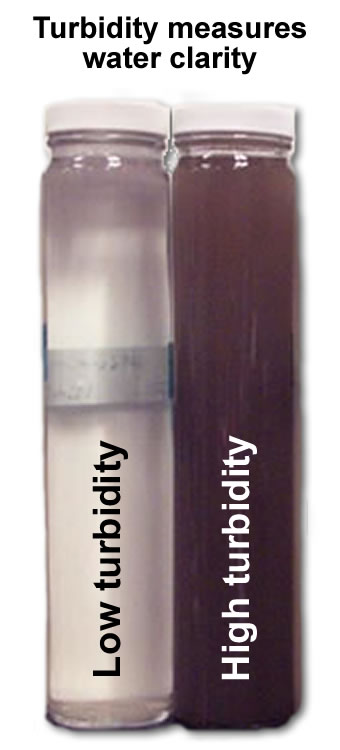
Turbidity refers to how clear the water is. Turbidity is linked to the look of water and therefore the public’s perception of water quality. People generally prefer water of high clarity for recreation and consumption. The turbidity of the water is determined by the type of river bottom, the pollutants, or the plant and animal life in the river. Turbidity is commonly linked to total suspended solids (TSS) because water with high TSS levels typically look murkier and have higher turbidity measurements. Common suspended solids are clay, silt, and sand from soils, phytoplankton (suspended algae), bits of decaying vegetation, industrial wastes and sewage.
Why is turbidity important?
Measuring turbidity in streams is an important indicator of the concentration of suspended sediments in the water. Sediments are a natural part of streams and other water bodies and even the most pristine streams in undeveloped watersheds will run muddy during high flows. Typically, after rainfall, the turbidity of the river increases with higher runoff rates.
Turbidity limits light penetration and hinders photosynthesis, thereby altering the composition and distribution of aquatic plant communities. Excessive fine sediment can fill the small spaces between the river bed gravel and reduce suitable habitat for many benthic invertebrates (e.g., mayflies, stoneflies, and clams) and spawning fish. This condition, called embeddedness, is widespread throughout the Minnesota River. Sediment absorbs solar energy, raising water temperatures and reducing the amount of dissolved oxygen. Sediment also carries nutrients, particularly phosphorus and toxic substances, such as PCBs and mercury. These may be released in the environment after sediment settles in the river bed (Basin Information Document, 1997).
What is the standard for TSS?
Minnesota's turbidity standard is measured in nephelometric turbidity units (NTUs). Turbidity is usually measured using an optical instrument in a laboratory called a nephelometric turbidimeter. The term Nephelometric refers to the way the instrument estimates how light is scattered by suspended particulate material in the water. The lower the NTU number the cleaner the water.
In Class 2A (coldwater fishery) and Class 2B (Cool or warmwater fishery) Waters of the State have set chronic turbidity standards of 10 NTU and 25 NTU, respectively where "chronic standard" means the highest water concentration of a toxicant to which organisms can be exposed indefinitely without causing chronic toxicity. Learn more about turbidity on water on the web.
References:
State of the Minnesota River: 2002 Surface Water Quality Monitoring.
Minnesota River: Basin Information Document. Minnesota Pollution Control Agency. November, 1997.
MPCA Glossary website - http://www.pca.state.mn.us/gloss/index.shtml
New York's Water Quality Network - http://www.nywaternet.org/html/tn.html
Water on the Web website - http://waterontheweb.org/under/waterquality/
Back to pollutants
For more information about turbidity in the Minnesota River Basin, see publications.
|
|
|