
Types of Monitoring in the Minnesota River Basin
|
Three types of monitoring in the Minnesota River Basin include long-term physical and chemical monitoring, biological monitoring, and volunteer monitoring.
|
||||
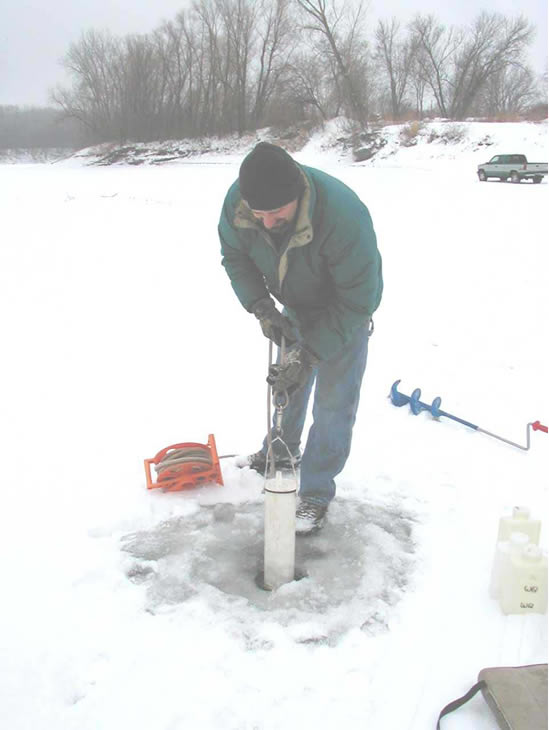 |
Long-term Physical and Chemical MonitoringAn inter-agency, long-term physical and chemical monitoring program involves a network of monitoring sites on the Minnesota River and sites near the mouth of its major tributaries. This network measures and documents the loads of various pollutants in the Minnesota River and its major tributaries via the incorporation of automated flow monitoring. Local watershed organizations also collect water quality data (watershed contacts). Several state and federal agencies and local groups currently are conducting monitoring within the Minnesota River Basin .Metropolitan Council Environmental Services (MCES), in conjunction with the Minnesota Department of Agriculture and the United States Geological Survey, operate long-term sites along the middle and lower Minnesota River. A number of additional sites are set up at or near the mouths of several of the Minnesota River’s major tributaries (see list of monitoring sites for 2002). |
|||
| Monitoring on the Minnesota River near St. Peter |
||||
 |
Biological MonitoringMuch work has been done in recent years in the development of biological monitoring tools for measuring and characterizing the health of our water resources using the actual biotic communities present in streams and rivers. Fish and macroinvertebrate communities, in particular, have been used successfully as indicators of river and stream quality. They are responsive to the cumulative effects of physical and chemical disturbances. Also, they are easily sampled, predictable in their occurrence, sensitive to human induced changes in their environment over time, and easily understood and recognized by the public to be important indicators of a healthy environment. Biological monitoring in the Basin builds upon the biological survey of the Minnesota River Basin completed during the Minnesota River Assessment Project (MRAP). During the MRAP, a fish-based multimetric Index of Biotic Integrity (IBI) was developed to assess stream quality based on the structure of the fish community. A macroinvertebrate-based IBI is still needed to complement the existing fish-based IBI. MRAP also provided the baseline information necessary to begin assessing the trends. Long term trend monitoring will continue to determine the status, extent, changes, and trends in water quality. |
|||
| Biological monitoring on the Le Sueur River |
||||
 |
Volunteer Stream MonitoringInterested in becoming a stream monitoring volunteer? Many organizations offer training to interested citizens. Any person or group willing to devote a small amount of time and energy to conduct simple stream checks on a regular basis can become a volunteer monitor. Both the Minnesota Pollution Control Agency (MPCA) and the Metropolitan Council Environmental Services (MCES) have citizen monitoring programs in place. Contact your local watershed group to see if there are other opportunities in your back yard (watershed contacts). Citizen Stream-Monitoring Program - MPCA Volunteer Stream Monitoring Partnership - MCES Contact your local watershed coordinator - Watershed Contacts |
|||
| Volunteer monitoring in the Chippewa River watershed |
||||
|
|
||||
