
Monitoring Focus in the Minnesota River Basin
Monitoring Focus & MethodsMarjor primary nonpoint pollutants of concern in the Basin include excessive sediment, phosphorus, orthophosphorus, nitrate-nitrogen, and pesticide concentrations. Previous studies found that the Minnesota River violated standards for bacteria, dissolved oxygen, and ammonia. In accordance with the Clean Water Act, the Minnesota Pollution Control Agency (MPCA) lists rivers and creeks within the Basin that have been designated as “impaired waters” due to pollution problems such as low dissolved oxygen, mercury, PCBs, fecal coliform, turbidity, and excess ammonia (http://www.pca.state.mn.us/water/tmdl.html). The Department of Health tracks PCB and mercury levels in fish and issues site specific fish consumption advisories (http://www.health.state.mn.us/divs/eh/fish/index.html).
|
||||
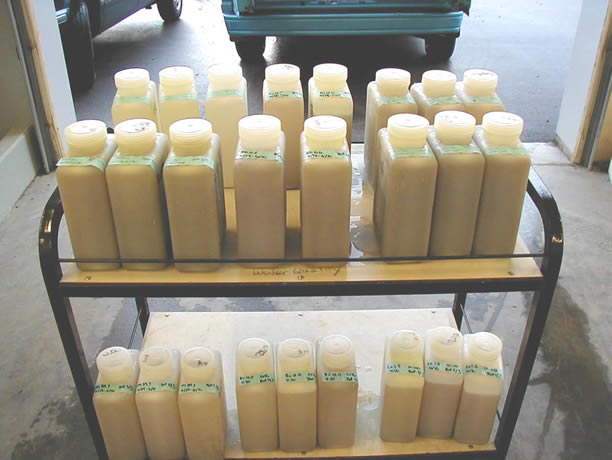 |
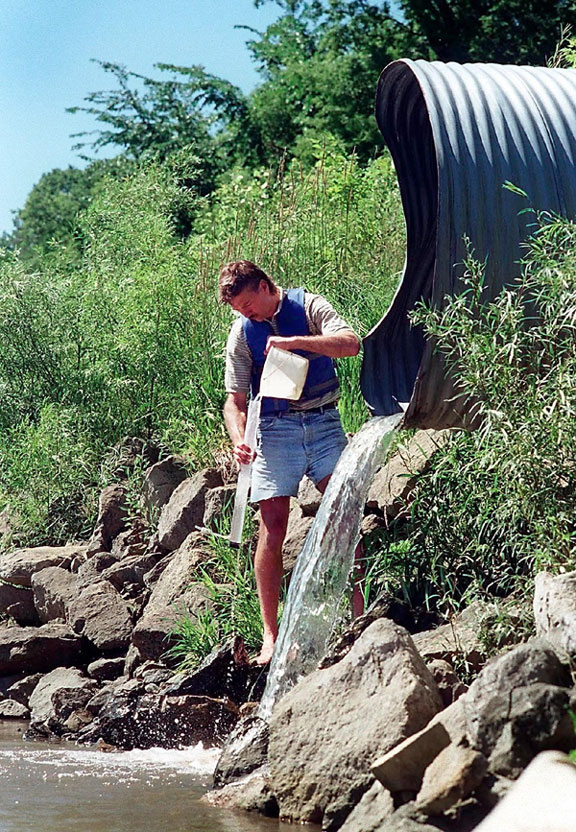
MethodsTwo primary methods of storm event sampling are used by projects in the Basin. Grab sampling is the collection of a discrete individual sample, either by manual means or with an autosampler. Flow-based composite sampling is the collection of a composite samples over all or part of a storm event, using an autosampler. Because monitoring in the Basin is a joint venture of many agencies and organizations, water quality data collection efforts and data processing methodologies vary somewhat. Organizations are moving toward a standard set of methods, a step that will further improve the accuracy of water quality comparisons across the Basin.
|
|||
 |
||||
|
|
||||
