
Minnesota River Basin - Advancing the Cleanup
 |
The Minnesota River attracted a lot of attention in the late1980s due to unhealthy fish populations, algal blooms, and sediment. In 1992, former Governor Arne Carlson announced an ambitious plan to clean up the Minnesota River. He issued a challenge to make it “swimmable and fishable” within 10 years. Many citizens, local and state government agencies, embarked on steps working towards this goal. Progress has been made but more work remains. The following details some of the efforts underway to work towards a cleaner Minnesota River on a basin, watershed, and local scale. Former Governor Arne Carlson (photo, left) issued the challenge: Make the river swimmable and fishable withint 10 years. <Photo courtesy of www.cleanairchoice.org> For more information: Progress on a Long Voyage: Decades of Effort Show Improvement in Minnesota River Water Quality. Minnesota Pollution Control Agency. January 2007. (pdf 1.2 mb) |
||
|
BASIN WIDE APPROACHES |
|||
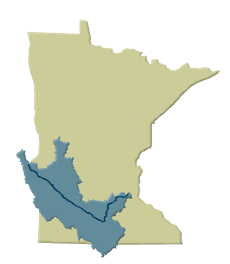 |
The first step was to better understand the river system and to define the problems facing the Minnesota River. From 1989-92, scientists conducted the first comprehensive study of the Minnesota River Basin, the Minnesota River Assessment Project (MNRAP). The study evaluated the magnitude of and the manner in which pollution was entering the Minnesota River. Influential Citizen Groups like the Minnesota River Citizen’s Advisory Committee and the Minnesota River Ag Team put forth a vision and approach for clean up. In order promote the orderly water quality improvement and management across the 37 counties with land that drain into the Minnesota River, the joint powers Minnesota River Board was created in 1995. In 1997, the Minnesota River Basin Data Center was created to collect, manage, and disseminate information collected throughout the Basin. In 1998, the largest, private-lands conservation effort in the state began on the Minnesota River to improve the river’s water quality and restore wildlife habitat. In just four years, more than 100,000 acres were secured into permanent conservation easements through the Conservation Reserve Enhancement Program (CREP). While diverse organizations have monitored water quality across the basin for many years, an interagency team began in 1999 to annually assemble and summarize data collected throughout the basin in the State of the Minnesota River: Summary of Surface Water Quality Monitoring Reports. In 2001, the Pollution Control Agency’s Minnesota Basin Plan provided a basin management approach to identify issues, set goals, and list strategies to clean up the river. |
||
|
WATERSHED EFFORTS |
|||
 |
Basin planning and major watershed planning has been occurring in the Minnesota River Basin since 1992. The Minnesota River Basin is divided into 13 major watersheds. Nearly every of the major watershed in the Basin has a watershed project working to improve water quality (see contact list). These projects organize local, state, and federal government along with private groups and citizens. Major watershed level planning activities include Diagnostic Studies and Implementation Plans (Minnesota Pollution Control Agency Clean Water Partnership (CWP) Projects). Local and minor watershed planning is also occurring across the Basin. All counties currently have local water plans. Cities are working across the basin to upgrade their wastewater treatment plants and improve stormwater runoff. Shoreland ordinances administered by Minnesota Department of Natural Resources (DNR) also help to minimize lake and stream pollution.
|
||
|
INDIVIDUALS/CITIZENS |
|||
 |
Numerous citizen groups are working to clean up the Minnesota River. Individual citizens are working across the Basin to improve water quality on their lands. The following are a few of the many examples across the Basin. |
||
|
This page was last updated 11/07
|
|||